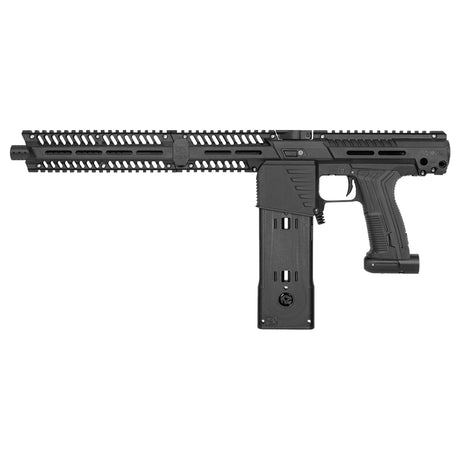
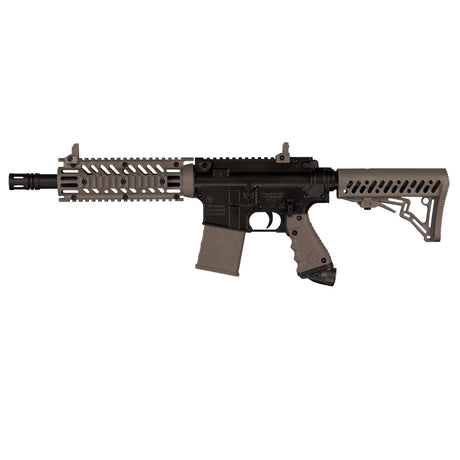
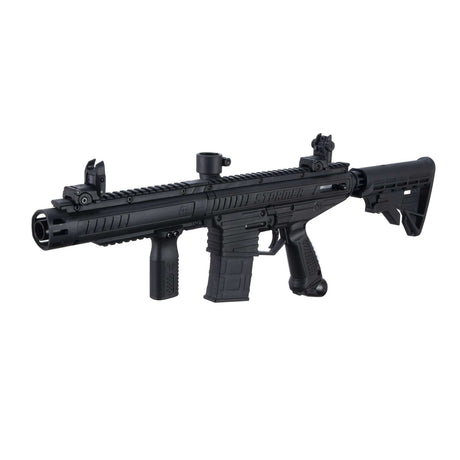
The right paintball gun must match the games you can actually play and the maintenance you are willing to perform. It should also fit your body and use air and ammunition that are realistically available nearby.
A marker with more features is not automatically a better first purchase. Reliability, field support, ergonomics, and total ownership cost matter more than an impressive specification list.
Start with the Type of Paintball You Plan to Play
Recreational paintball
Mechanical hopper-fed markers are simple, durable, and widely supported. They are a strong choice for casual play, loaner equipment, and players who want high capacity without magazine management.
Woodsball and scenario paintball
Woodsball markers benefit from durability, comfortable air placement, easy cleaning, and enough capacity for longer games. Hopper-fed, magfed, and dual-feed systems can all work.
Magfed paintball
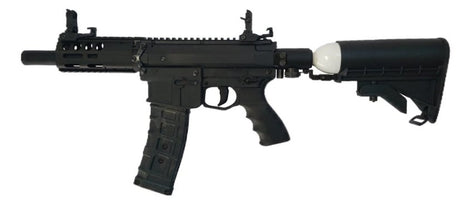
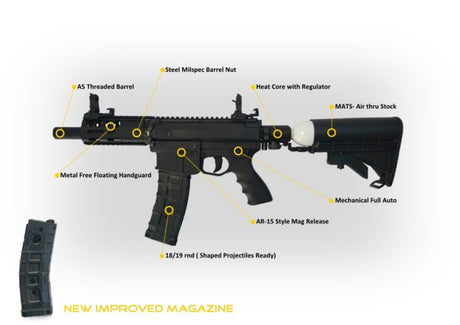
Magfed markers use detachable magazines and reward reload planning, communication, and equipment discipline. Consider magazine price, availability, shaped-projectile compatibility, and upgrade support.
Speedball
Speedball markers prioritize lightweight handling, high-rate electronic operation, consistent air delivery, and compatibility with modern loaders and pod systems.
Training and specialty use
Training organizations, less-lethal users, and specialty programs have different legal, safety, projectile, power, and procurement requirements. Do not choose a marker for these uses without confirming the exact application and local rules.
Mechanical vs. Electronic Markers
Mechanical markers operate without an electronic firing system. They are often easier to store and maintain, and many remain highly effective in recreational, scenario, and magfed play.
Electronic markers can provide adjustable firing modes, lighter trigger operation, and higher rates of fire where fields permit them. They also introduce batteries, programming, waterproofing considerations, and event-specific mode limits.
Hopper-Fed, Magfed, or Dual-Feed
| Feed type | Strengths | Considerations |
|---|---|---|
| Hopper-fed | High capacity, simple replenishment, broad field compatibility | Top-mounted profile, loader and pod requirements |
| Magfed | Deliberate reloads, realistic handling, role-based loadouts | Lower capacity, magazine cost, more equipment management |
| Dual-feed | Flexibility across game formats | Added components and platform-specific conversion procedures |
Caliber and Ammunition
.68 caliber is the most common traditional paintball size..50 caliber can reduce weight and impact energy in certain applications but uses different paint, magazines, barrels, and field rules.
Some magfed platforms support shaped projectiles. Compatibility depends on the marker, magazine, breech, and barrel. Field approval is required.
Air-System Compatibility
Confirm whether the marker uses HPA, CO2, proprietary cartridges, or another source. For HPA, consider tank pressure, regulator output, shot count, refill availability, and how the tank affects balance.
A marker that feels comfortable with no tank may feel completely different once the actual air source is installed.
Fit and Ergonomics
- Can the player shoulder or hold the marker while wearing the mask?
- Can the controls be reached without changing grip?
- Is the marker too long or front-heavy?
- Can magazines, hopper, or pods be reloaded comfortably?
- Does the stock or air tank interfere with the mask?
- Can the marker be used from either side when needed?
Reliability and Parts Support
Research common wear parts, magazine availability, manufacturer support, local technicians, and how difficult the marker is to clean. A discontinued or highly proprietary marker may be a poor first choice even when the purchase price is attractive.
Total Ownership Cost
Budget beyond the marker. The complete cost may include:
- Certified mask
- Air tank and fill equipment
- Hopper or magazines
- Pods, pouches, or carrying system
- Barrel cover
- Maintenance tools and lubricant
- Spare seals and batteries
- Transport case
- Field fees, paint, and air
- Platform-specific upgrades
Questions to Ask Before Buying
- Which fields and events are realistically available?
- What feed system fits those games?
- What ammunition and air can be purchased locally?
- Does the marker fit while wearing the intended mask?
- Are magazines and replacement parts easy to obtain?
- Who can service the marker?
- What does the complete setup cost?
- Can the marker grow with the player's needs without requiring a full rebuild?
Common Buying Mistakes
- Buying based on appearance alone
- Ignoring the cost of magazines or loaders
- Choosing an air tank before checking balance and shot count
- Assuming a marker supports shaped projectiles
- Buying a discontinued platform with limited parts
- Spending the mask budget on marker accessories
- Purchasing upgrades before using the base marker
Good Starting Directions
Simple recreational setup
Choose a proven mechanical marker, comfortable mask, dependable HPA tank, basic loader, barrel cover, and cleaning kit.
First magfed setup
Choose a supported magfed or dual-feed platform, several reliable magazines, the correct air system, a simple carrying setup, and field-compatible ammunition.
Custom platform build
Start with the base platform and mission. Use builder tools to verify handguards, grips, air routing, barrels, optics, and accessory compatibility before ordering.
Choose the Platform, Then Build the Loadout
The marker is one part of a complete system. Select it alongside the mask, air, loading equipment, maintenance plan, and games available nearby.
Compare Magfed Paintball Guns, use Beginner Loadout and Buying Guides, or open Build Guides and Upgrades for platform-specific planning.


![First Strike T15 Prime Paintball Gun [No Bottle] - Gen 5](http://hrtacticalin.com/cdn/shop/files/first_strike_t15_2021__51270_1280x_a8688575-7744-4489-b7d9-0f02ec15d0fb.jpg?v=1762458826&width=460)