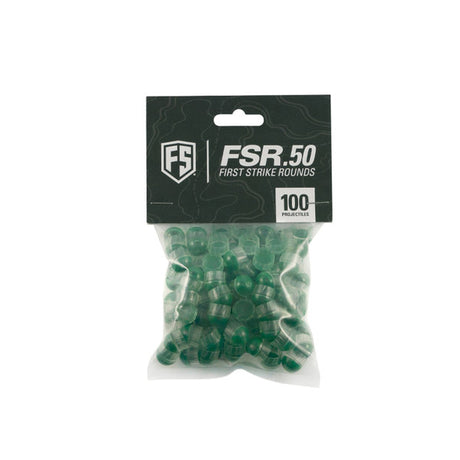
First Strike Rounds (FSRs) have changed magfed paintball, offering players greater range and accuracy. But one question continues to surface: are they safe?
Field owners and insurance providers sometimes hesitate to allow FSRs, fearing they may cause higher injury risk. This guide addresses those concerns using independent ASTM-backed testing and real-world field practices.
If you’re looking to equip your setup with the right shaped projectile ammo, check out our range of Ammo & Shaped Projectiles for magfed markers.
What Are First Strike Rounds?
First Strike Rounds are shaped paintball projectiles designed specifically for magfed markers, where precision and controlled engagement are emphasized.
Design and Shape
FSRs feature a fin-stabilized skirt with a round, paint-filled nose. This design allows the projectile to self-stabilize in flight rather than relying on spin alone.
Range and Accuracy
Because of their shape, FSRs maintain a straighter trajectory at longer distances. This makes them popular among players using magfed markers, where precision and controlled engagement are emphasized over volume of fire.
Independent ASTM Impact Force Study
In 2015, an independent engineering firm presented a formal impact force comparison study to ASTM Subcommittee F08.24. The purpose was to objectively compare First Strike Rounds with standard .68 caliber spherical paintballs of similar mass and velocity.
Testing Methodology
The study used calibrated impact sensors under controlled laboratory conditions. Both projectile types were fired at identical velocities to eliminate external variables and ensure an accurate comparison.
Key Findings
The results showed minimal differences between the two projectile types:
-
Average peak force difference: less than 10 percent
-
Peak force under identical conditions: less than 4 percent
-
Total impact force difference: less than 7 percent
The testing concluded that there is no practical difference in impact force between First Strike Rounds and traditional spherical paintballs when fired at the same velocity. The finned design does not increase impact severity.

Click above to view the full ASTM impact force report (PDF).
Insurance vs Field Policy
A common misconception is that insurance providers broadly prohibit the use of First Strike Rounds. In reality, most paintball insurance policies are structured around ASTM standards and documented risk assessments.
Since independent ASTM testing shows no meaningful increase in impact force, there is no universal insurance exclusion specific to FSRs. When fields choose to restrict their use, it is typically a field-level policy decision, not an insurance mandate.
Best Practices for Field Owners
Like any paintball equipment, safety is determined by how it is used and regulated on the field.
Velocity Control
All markers should be chronographed at or below established field velocity limits, regardless of projectile type.
Marker Compatibility
FSRs should only be used in markers designed to fire shaped projectiles. This ensures consistent performance and minimizes equipment-related issues.
Player Education
Clear communication around engagement distances, responsible shot selection, and field rules plays a major role in overall safety.
Documentation and Transparency
Field operators who allow shaped projectiles should document their procedures and reference ASTM testing when communicating with insurers.
The Bottom Line
When used within standard paintball safety rules and velocity limits, First Strike Rounds are no more dangerous than traditional paintballs. Independent ASTM-backed testing confirms that they do not hit harder, and real-world field use has not shown increased injury rates.
For fields and players alike, informed decisions should be based on data rather than assumptions. Proper marker selection, enforcement of safety rules, and adherence to established standards remain the most important factors in maintaining a safe playing environment.